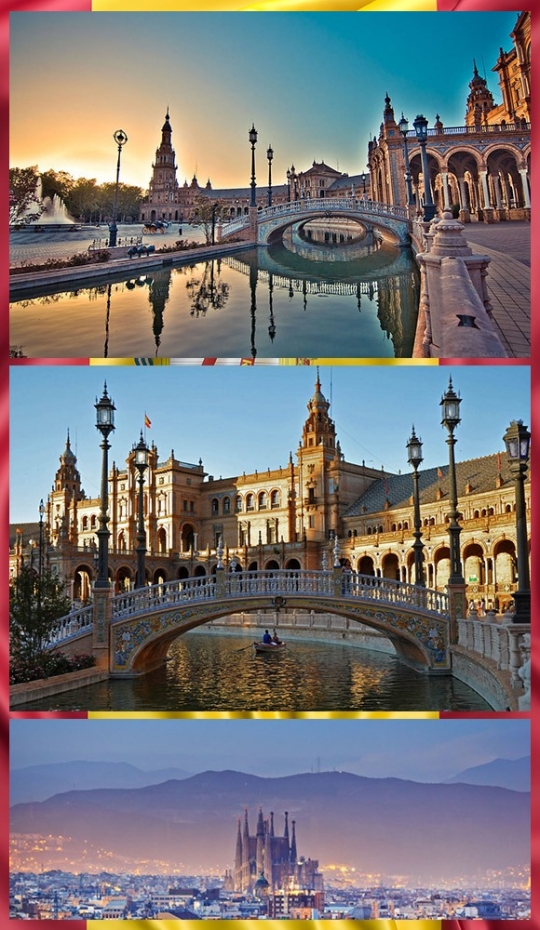
Unique and colorful Spain! The homeland of flamenco and bullfights. Renowned for the unique creations of the genius Antoni Gaudí in Barcelona, fashionable resorts of the Mediterranean, the Atlantic Ocean, and the Canary Islands.
With its abundance of major historical and architectural landmarks, Spain occupies a leading position in Europe and the world. Even if you focus solely on the most significant monuments, the list will be enormous. Just the capital - the magnificent Madrid - can reveal new wonders to you day after day. From the central square - Plaza del Sol, to the Habsburg district - the most influential monarchy in Europe throughout its history, and numerous churches, cathedrals, basilicas, palaces, and monasteries, some of which are over 500 years old. One of Madrid's symbols is the Fountain of the Goddess Cybele, surrounded by the most famous landmarks of the Spanish capital - the Linares Palace, the General Staff, the Bank of Spain, and the Neptune Fountain. Additionally, outdoor enthusiasts can visit the Royal Retiro Park, the beautiful Real Jardín Botánico founded in the 18th century, or venture outside the city to Casa de Campo - a huge estate housing a zoo and an amusement park. The Royal Monastery of El Escorial is particularly noteworthy - a palace that has been a monastery, a royal residence, and a mausoleum throughout its history. Sometimes referred to as a "monotonous symphony in stone," over its 450-year history, it has accumulated countless cultural treasures within its walls. Traveling through Spain, one can admire the Palace of Catalan Music in Barcelona, the Roman Aqueduct in Segovia, the incredibly beautiful Alhambra Palace of the Muslim kings in Granada, the Alcazar Castle and bridges over the Tagus River in Toledo, the University of Salamanca where Columbus and Cervantes studied - and this is only a tiny fraction of the wonders of this marvelous country, where epochs and cultures intertwine for centuries.
From 1996 to 2000, Spain underwent an educational reform. Alongside the old education system inherited from 1970, a new, and in some centers, its own experimental education system was implemented in Spain. Primarily, the reform affected primary and secondary education, while regarding universities, it's worth noting that each university in Spain is autonomous and can make its (sometimes significant) changes to the curriculum.
In Spain, universities are the main type of higher education institutions, accounting for 95% of the total number of universities. The country also has a number of other higher education institutions, which typically prepare specialists in specific areas such as arts or military affairs. Spain has both public and private universities. Currently, there are 46 public and 12 private universities in Spain officially recognized by the state. Instruction in the majority of Spanish universities is conducted in Spanish. Foreign citizens can undergo a course in Spanish language and culture offered by many universities.
To learn a language, one must do so where it is spoken - it's hard to disagree with this method, especially after experiencing its effectiveness firsthand. No complexes will help - you'll start speaking anyway. The immersion method in the language environment works flawlessly, albeit only with the right approach to it.